David A. Maass
Biography
David A. Maass was an acclaimed American wildlife painter whose detailed portrayals of waterfowl, game birds, and the natural landscapes of North America established him as one of the most recognizable figures in American sporting and conservation art. Over a career spanning more than six decades, his paintings and limited-edition prints combined meticulous attention to wildlife anatomy and behavior with atmospheric compositions that captured the beauty and character of the natural world.
Born November 27, 1929, in Rochester, Minnesota, Maass developed an early appreciation for wildlife and the outdoors. Largely self-taught as an artist, he refined his abilities through observation, drawing, and a lifelong engagement with the natural environment. He served in the United States Marine Corps and later worked for Jostens, where he became an art director before pursuing wildlife painting as his principal career.
Maass achieved national recognition through his extraordinary success in wildlife conservation art. He won the prestigious Federal Duck Stamp competition twice, in 1973 and 1981, producing the stamps issued in 1974 and 1982. His accomplishments extended well beyond the federal program, encompassing numerous state duck stamps, wild turkey stamps, and conservation fundraising prints. His designs supported organizations dedicated to preserving wetlands, wildlife habitats, and North America's sporting traditions.
His association with Ducks Unlimited became an important part of his professional legacy. Maass was named the organization's Artist of the Year five times—in 1974, 1988, 2004, 2013, and 2016—reflecting both the enduring popularity of his work and his contributions to conservation fundraising. He also received recognition from the National Wild Turkey Federation and other wildlife organizations.
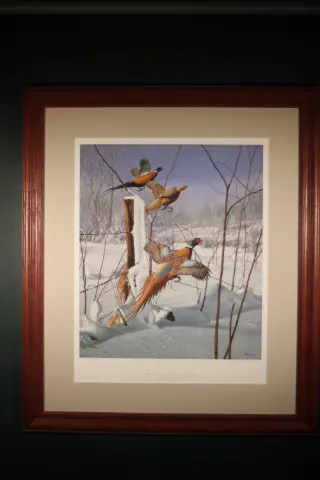
Working primarily in painting, Maass developed a distinctive naturalistic style characterized by carefully rendered birds, convincing environmental detail, and a sophisticated understanding of light and atmosphere. His compositions frequently depict ducks rising from mist-covered wetlands, pheasants moving through autumn fields, and waterfowl navigating marshes and waterways. Rather than presenting wildlife as isolated specimens, Maass placed his subjects within richly observed habitats, creating compositions that convey both movement and a sense of place.
His longstanding relationship with Wild Wings, the Minnesota-based publisher of wildlife and sporting art, brought his paintings to a wider collecting audience through signed and numbered limited-edition prints. More than 300 of his images were reproduced through the publisher, making his work familiar to generations of wildlife art enthusiasts. His paintings also appeared in nationally distributed calendars, conservation publications, and sporting art exhibitions.
Maass's work received institutional recognition during his lifetime. His paintings and prints were exhibited in galleries and wildlife art exhibitions throughout the United States, including exhibitions associated with the Smithsonian Institution's National Collection of Fine Arts in Washington, D.C. His accomplishments were also recognized by U.S. ART, which named him a Master Artist in 1997.
Although widely known for his commercial prints, Maass's artistic reputation rested on his original paintings and his ability to translate firsthand observation of wildlife into compelling visual narratives. His understanding of bird behavior, habitat, seasonal changes, and atmospheric conditions distinguished his compositions from purely decorative wildlife imagery.
David A. Maass died on April 29, 2026, at the age of 96. His legacy extends beyond the paintings and prints he created. Through decades of conservation artwork, fundraising contributions, and the widespread distribution of his images, he helped bring an appreciation of North American wildlife into homes and collections across the country.
His surviving body of work remains a testament to the relationship between artistic observation and conservation—a career devoted not simply to depicting wildlife, but to celebrating the environments in which it lives.