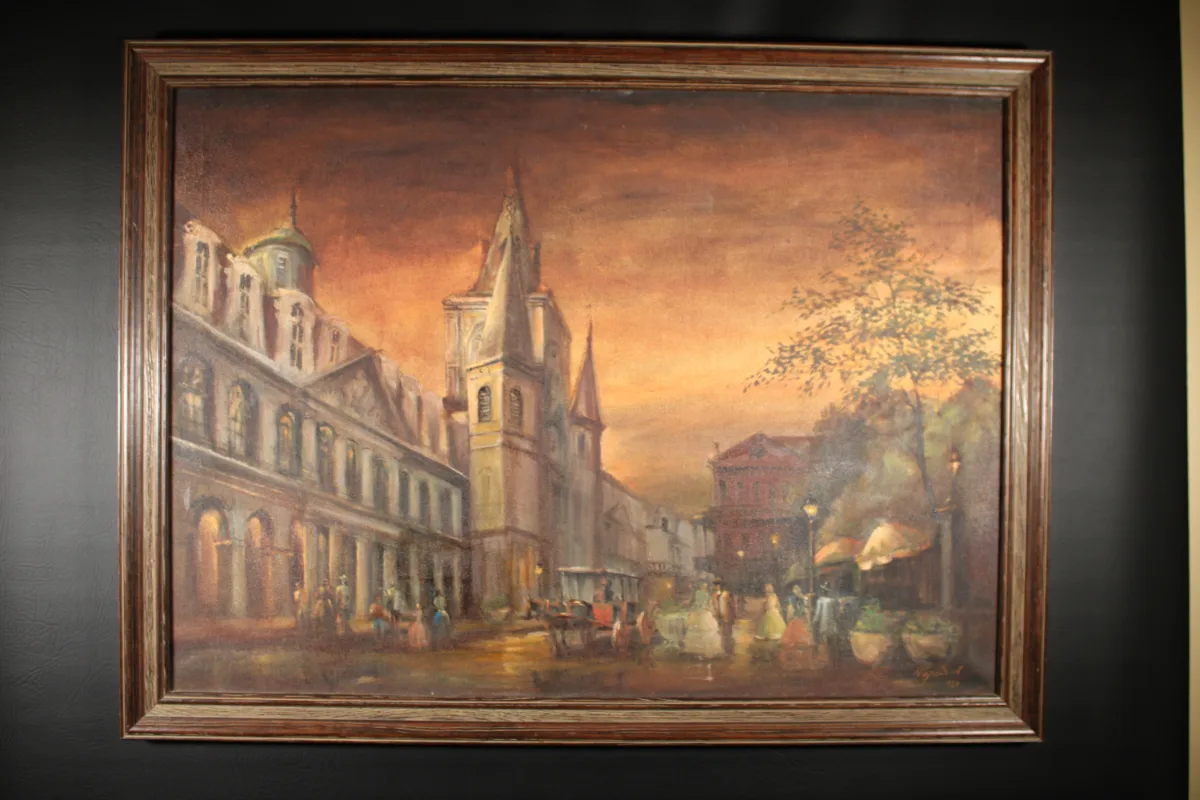
A Creative Life in the French Quarter
HAROLD “NAPOLEON” KING1940-2005
About HAROLD “NAPOLEON” KING
1940–2005
---
King was born in Miami, Florida, on October 22, 1940, and grew up in Florida, New Jersey, and New York. One of eleven children in his household, including two foster children, he demonstrated artistic ability early, producing illustrations for his high-school newspaper. His classmates gave him the nickname “Napoleon,” reportedly because of his ambition and the numerous part-time jobs he held while attending school.
After high school, King went to New York’s Greenwich Village to develop his abilities, drawing portraits on weekends. He had no conventional academic art training and described himself as self-taught. Through sustained work in charcoal and pastel, he developed the dramatic approach he called “Napoleonic Impressionism.” King described his method as working with masses while maintaining a strong awareness of line, allowing the viewer to perceive elements beyond those explicitly rendered.
An important element of King’s art was his fascination with the past. Historical settings, architecture, clothing, and atmosphere recur throughout his work. He explained this tendency simply: “I can still see the past in today.”
King moved to New Orleans in 1970 and quickly became part of the French Quarter’s street-art community. He worked around Pirate’s Alley and Royal Street, producing portraits and exhibiting his artwork directly to the public. Contemporary photographs from 1974–75 document King working on Royal Street and near Pirate’s Alley.
His presence was distinctive. During his early New Orleans years, King sometimes worked in elaborate period-inspired clothing and was accompanied by his pet rabbits. Yet behind the theatrical appearance was a serious commitment to drawing and painting. By 1975, King was increasingly reducing his street portrait work to concentrate on developing his studio practice.
As an African American artist working publicly in the French Quarter during the 1970s, King also became part of the history of the Jackson Square artistic community. Artist Jim Bilgere, who knew King from childhood and later studied painting with him, has described King as an important early mentor and identified him as the first Black artist to paint on Jackson Square.
King’s subjects increasingly reflected the city around him. French Quarter streets, Jackson Square, St. Louis Cathedral, Bourbon Street, historic houses, riverfront activity, bayous, and Louisiana landscapes appear throughout his surviving body of work. Many compositions deliberately evoke an earlier New Orleans through horse-drawn carriages, historic dress, architectural details, and scenes suggesting the city’s past.
He worked across several media, including oil, acrylic, charcoal, graphite, colored pencil, watercolor, and pastel. His works range from intimate drawings to substantial canvases. Regardless of medium, strong draftsmanship and architectural structure frequently underpin his compositions.
King continued producing images of New Orleans and Louisiana for decades. His works remain active on the secondary market, with paintings and works on paper appearing through established regional auction houses. Documented subjects include Street Scene on Jackson Square, The French Quarter at Night, St. Louis Cathedral, Bourbon Street, Lafitte’s Blacksmith Shop, Louisiana bayou scenes, and historical French Quarter compositions.
Harold “Napoleon” King died in New Orleans on September 27, 2005, in the aftermath of Hurricane Katrina. He was 64.
King left behind more than a pictorial record of New Orleans. For approximately thirty-five years, he was part of the artistic environment he depicted—a self-taught African American artist who arrived in the city in 1970, established himself within the French Quarter community, influenced another generation of artists, and repeatedly returned to the history and character of New Orleans as the central language of his work. His surviving work records a city he spent decades observing—not from a distant studio, but from within its streets.